

Hi! It’s konkaz (@konkazuk).
You’ve probably come across the phrase “carbon footprint” in the news or environmental articles, but have you ever thought about how it’s actually used in everyday life?
Carbon footprints already exist in our everyday lives — from labels on products to the decarbonisation plans of companies.
However, many people still don’t really understand what those numbers mean or how they connect to everyday life.
In this article, we’ll look at what a carbon footprint is, where it’s used, and how we should think about it in our everyday lives.
Why carbon footprints matter now

We’ve been hearing the term “carbon footprint” more often in recent years, and some companies and brands have started voluntarily displaying carbon footprint information on their products. That said, on a global scale, it has not yet become widespread.
The thing is: why is it becoming so important for us to understand this now?
To put it simply, we’ve lived for years taking resources for granted and pumping out smoke to enjoy convenient lifestyles. But now, as the impacts of climate change become visibly severe, it’s time to face this issue seriously.
Facing this reality means understanding the exact amount of CO₂ being emitted, rather than just relying on a vague sense of it.
What is a carbon footprint?

A carbon footprint is…
a way of putting a number on how much carbon dioxide is produced by the products and services we use, from production through to disposal.
The point here is to move away from a vague sense of “this doesn’t seem very good for the environment” and instead look at how our daily choices impact the environment using specific figures.
What’s distinctive about this approach is that it looks beyond the factory where a product is made, and considers emissions we don’t usually think about — such as raw material extraction, transport, energy use while the product is being used, and what happens when it is thrown away or recycled.
For example, even a single shirt generates carbon dioxide emissions in many different ways between being produced and being thrown away.
A carbon footprint is basically a way to add up all these emissions and make them visible.
How is a carbon footprint calculated?

A carbon footprint is calculated by adding up the amount of carbon dioxide emitted throughout the entire process…
Material sourcing → Production → Transport → Use → Disposal / Recycling
*By the way, this whole process is called the “life cycle”.
Take one smartphone, for instance…
▪️Mining rare metals like lithium and cobalt
▪️Making parts and assembling the phone in factories across the world
▪️Transporting materials and products — from raw materials to factories, then to warehouses and shops, often crossing borders multiple times
▪️We charge and use our phones every day, and that also includes the electricity used by clouds and communication networks
(Your phone isn’t just working in your hand — it’s constantly linked to massive computers around the world)
▪️Electronic waste
(Taking phones apart, separating metals, and high-heat processing can cause serious environmental damage if they’re not recycled)
At each of these stages, carbon dioxide is released.
So basically, a carbon footprint adds all of this together and puts a number on it by saying, “this product emits about this much in total”.
Of course, it isn’t easy to measure these emissions perfectly, so international guidelines and shared rules are used to keep the calculations as consistent as possible.
Where carbon footprints are used
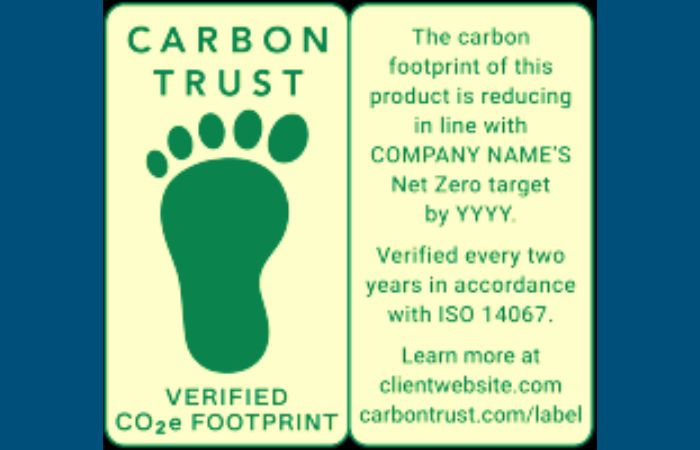
Carbon footprints are not only an issue for manufacturers and related companies. They are already being applied in our everyday lives.
For instance, in the UK, the large alternative meat brand Quorn Foods shows Carbon Trust-certified carbon footprint data on many of its popular products. Likewise, the popular fashion brand Allbirds, known for its shoes, seems to display the carbon footprint for every product.
In recent years, you can also find carbon footprint data on the grey-packaged Oatly oat milk that’s often used in coffee at many cafes.
(However, this information is not included on the standardised packaging for the EU market.)
So, in this way, some companies have begun initiatives to display on product packaging or websites how much carbon dioxide is emitted in the production of their products.
On the other hand, for companies, carbon footprints are not used as a way to say “we care about the environment”. Rather, they serve as a tool to understand where emissions are highest and as a metric to identify which areas of production improvements would have the greatest impact.
With moves like this, it seems certain that in the near future, displaying carbon footprint information will become mandatory.
In conclusion

So, from all this, you can see that the main point of carbon footprints is looking beyond the smoke from factories and thinking about all the emissions happening behind the scenes.
It also considers parts that are hard to see, like…
▫️Are raw materials being sourced from far away?
▫️Is a lot of electricity being used during operation?
▫️Does disposal produce a lot of CO₂ during incineration?
The first step we can take as individuals is to know which products produce how much CO₂ and where it’s coming from.
Being aware of carbon footprints helps us reconsider our daily lives and pause to ask ourselves, “Is this choice at least a little better for future generations?”
I believe this kind of small, consistent effort really matters.

Carbon footprints are likely to become a bigger part of our everyday lives, so it’s a good idea for everyone to understand how they work now.
Thanks for reading all the way through!
Bye for now,
konkaz
*You can read this blog post in Japanese from the link below.
👉 なぜ今カーボンフットプリントが重要なのか?数字で見る気候変動の現実