

Hi! It’s konkaz (@konkazuk).
In the last article, “CO₂ Emissions Per Day Per Person: Real Numbers You Can Relate To”, we looked at roughly how much CO₂ the average person produces in a single day.
This time, we’re turning our attention to food, which is often said to make up about 20 to 30 percent of a person’s carbon footprint, and exploring how different kinds of meals lead to different levels of CO₂ emissions using real world examples.
* To keep things simple, this article uses “CO₂” to describe overall greenhouse gas emissions. In reality, the numbers represent CO₂ equivalents (CO₂e), which also include gases like methane.
The carbon footprint of what we eat

First, let’s quickly recap the idea of carbon footprint.
A carbon footprint refers to…
the total amount of greenhouse gases emitted throughout the entire life cycle of a product, service, organisation, or activity, including its production, use, and disposal.
When we talk about the carbon footprint of food, it covers all the steps involved, whether the food is cooked or not:
– Growing the ingredients
– Processing them
– Transporting them
– Keeping them in the fridge
– Cooking
– Throwing away food waste
All the CO₂ from these steps adds up to the meal’s carbon footprint.
This means that the total CO₂ from our meals can change a lot depending on what we choose to eat. As a rough guide, food-related emissions are often described like this…
▫️ Beef → very high
▫️ Pork and chicken → medium
▫️ Fish, eggs, and dairy → fairly low
▫️ Beans, vegetables, and grains → very low
So here, we’ll go through these four categories one by one and look at their carbon footprints using real examples and numbers.
Beef dishes (high emissions)
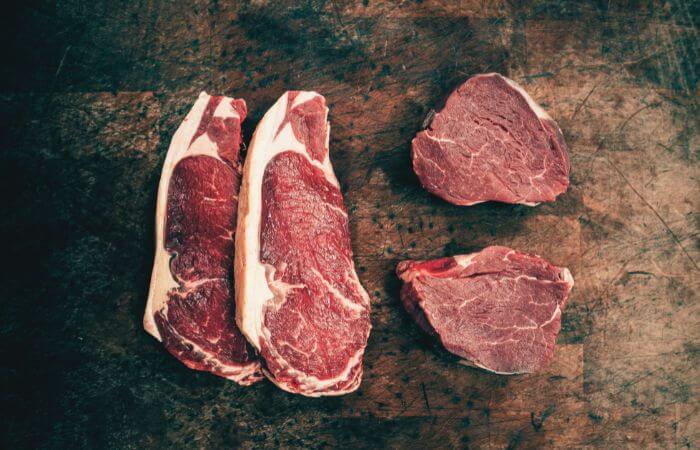
To start with, beef is a typical example of a food with the highest carbon footprint.
The carbon footprint of producing 1 kilogram of beef, including everything from production to transport and retail, is estimated to be around 25 to 60 kilograms of CO₂.
Taking an average, it is often simplified to about..
30 kilograms of CO₂ per kilogram.
And one of the main reasons beef has a higher carbon footprint than other meats is that…
cows are ruminant animals and release large amounts of methane during digestion.

Methane is about 28 times more powerful than CO₂ when it comes to warming the planet.
In addition, producing feed requires large amounts of land, which often leads to deforestation and related CO₂ emissions. Cattle also take a long time to grow, making energy use less efficient.
🔹 How much CO₂ does one beef meal produce?
If we look at beef sold in Japanese supermarkets, portion sizes are generally…
Thinly sliced or cut beef: 150〜250g
One steak: 180〜250g
A yakiniku portion for one person: around 200g
So, it’s fair to think of about 200 grams as a typical serving size.
Meanwhile, in the UK, steak is typically sold in packs of around 250 grams, so it’s reasonable to think of about 250 grams as one serving.
Therefore, based on an estimated carbon footprint of about 30 kilograms of CO₂ per kilogram of beef, this gives the following emissions per meal…
🇯🇵 0.2kg × 30kg = around 6kg of CO₂
🇬🇧 0.25kg × 30kg = around 7.5kg of CO₂
*Just to clarify: the 2〜3 kg of CO₂ per beef meal mentioned in the previous article was based on meals like gyudon or convenience-store bentos, which typically use only 50100 g of beef. If you’re eating steak or yakiniku, where you might consume around 200 g of beef, the emissions can jump to around 6 kg of CO₂ for a single meal.
Examples
One beef bowl (gyudon)
➔ 0.07kg × 30kg = about 2kg of CO₂
200 g of grilled beef (yakiniku)
➔ 0.2kg × 30kg = about 6kg of CO₂
One steak
➔ 0.25kg × 30kg = about 7.5kg of CO₂
Pork and chicken dishes (moderate emissions)

Next, let’s look at pork and chicken.
While their emissions are lower than beef, they still generate a fair amount of CO₂.
For pork and chicken, the numbers look like this…
Pork : about 10〜13kg of CO₂ per kilogram
Chicken : about 5〜7kg of CO₂ per kilogram
Both are much lower than beef.
Pigs and chickens are not ruminant animals like cows, so they produce very little methane during digestion. They also grow faster and need less feed to gain weight, which helps keep emissions lower.
However, there are still emissions from growing feed and dealing with animal waste, so the impact is not zero.
If we compare them to beef for the same 1 kilogram…
Pork : about 1/2 to 1/3 of beef’s emissions
Chicken : about 1/5 of beef’s emissions
This clearly shows why chicken is often said to have the lowest carbon footprint among meats.
Fish, eggs, and dairy (lower emissions)

▪️CO₂ emissions from fish
Fish are usually seen as a greener choice than meat, but in fact, CO₂ emissions can vary quite a bit depending on how the fish are caught or farmed.
Here’s a table with some typical examples…
| Type of seafood | Examples | Carbon Footprint | Key reason |
| Farmed fish | Salmon | About 4〜6kg | Energy use and feed production |
| Small wild fish | Sardines, mackere | About 1〜3kg | No feed and efficient fishing methods |
| Bivalve shellfish | Mussels, oysters | Less than 1kg | Naturally feed on plankton |
| Crustaceans | Shrimp, crab | 5〜10kg or more | High energy use in both farming and fishing |
As you can see, despite the common image of seafood as low-carbon, crustaceans are among the higher emitters within this category.
One important thing to keep in mind is the fishing method. For example, bottom trawling uses large amounts of fuel, which can significantly increase emissions even for the same type of fish.
In other words, not only the species itself, but also how the fish is caught is a key factor in understanding its carbon footprint.
▪️CO₂ emissions from eggs and dairy products
Eggs and dairy products are generally thought to have a higher carbon footprint than plant-based foods, but a lower one than meat.
Eggs : about 4〜5kg of CO₂ per kilogram
Milk : about 1〜2kg of CO₂ per kilogram
However, one food that is often overlooked is cheese. Because producing cheese requires large amounts of milk, its carbon footprint ends up being quite high.
Cheese : about 8〜13kg of CO₂ per kilogram
Cheese actually has higher emissions than chicken, and for some varieties and production methods, it can be roughly on par with pork.
Beans, vegetables, and grains (very low emissions)
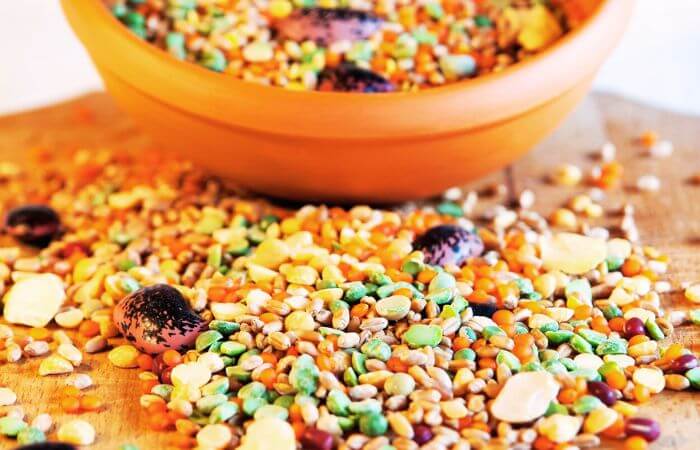
And finally, there’s plant-based food — things like beans, vegetables, and grains.
In short, their overall carbon footprint is quite low, making them one of the least environmentally impactful groups in our diet.
The carbon footprint for producing 1 kilogram of these foods is roughly…
Legumes (soybeans, lentils, etc.) : about 0.5〜2kg CO₂
Rice : about 2〜4kg CO₂
Wheat and bread : about 1〜1.5kg CO₂
Vegetables (potatoes, carrots, etc.) : about 0.2〜0.8kg CO₂
Rice tends to have a slightly higher carbon footprint due to methane emissions from paddies, but it is still far lower than that of meat or fish.
The reasons for this include…
▫️Plant-based foods are eaten directly, without going through livestock, making them more efficient.
▫️They produce almost no methane, unlike ruminant animals.
▫️They generally require less land, water, and energy to produce.

Put simply, their production is straightforward, with minimal energy wasted.
When you compare them, the same amount of emissions can make 15〜50kg of beans, but just 1kg of beef.
The difference here is huge.
Of course, beans and meat have different kinds of amino acids, but eating mostly meat for your protein clearly ends up speeding up environmental destruction.
Summary

From all of this, it should be clear that what we eat every day can make a big difference in the amount of greenhouse gases we emit.
The key takeaway is that beef has a major impact on the overall carbon footprint of our meals.
Even among meats, the emissions can vary a lot depending on the type.
The important point is not necessarily to eliminate certain foods entirely, but to be mindful of how much and how often we eat them.
Just cutting back on beef and switching to chicken, fish, or beans can really slash your greenhouse gas footprint.
By around 2050, if the global average temperature rises by 2°C compared to pre-industrial levels, we could face a serious global food crisis.
To prevent this from happening, we must limit global warming to under 1.5°C by 2030.
And to achieve this, each of us needs to keep our daily CO₂ emissions to around 6 kilograms or less.
With these points in mind, let’s pay close attention to what we eat every day.
Until next time,
konkaz
*You can read this blog post in Japanese from the link below.
👉 私たちの食事はどれくらいCO₂を排出しているのか?食品別にわかりやすく解説