
Hi! It’s konkaz (@konkazuk).
In the previous article, I explored how different types of diets affect our carbon footprint.
But after food, one of the biggest sources of CO₂ emissions is ‘transport‘ — which is what I want to focus on this time.
By gaining a rough understanding of carbon footprints in transport, there are many ways we can help create a society that’s safer and more livable, not just for us, but for the next generation as well.
However, before we get into that, the way we look at carbon footprints differs slightly between food and transport. So let’s quickly get that straight first.
Food is used up every time we consume it, so it needs to be produced again each time. Transport, by contrast, is made once and used over and over again, so in everyday discussions, the emissions from making it are usually left out.
With this in mind, I’d like you to continue reading.
*Just as in the previous article on food, I use “CO₂” here for the sake of clarity to mean total greenhouse gas emissions. In practice, this includes other gases such as methane and is measured as CO₂e.
CO₂ emissions per km by transport mode
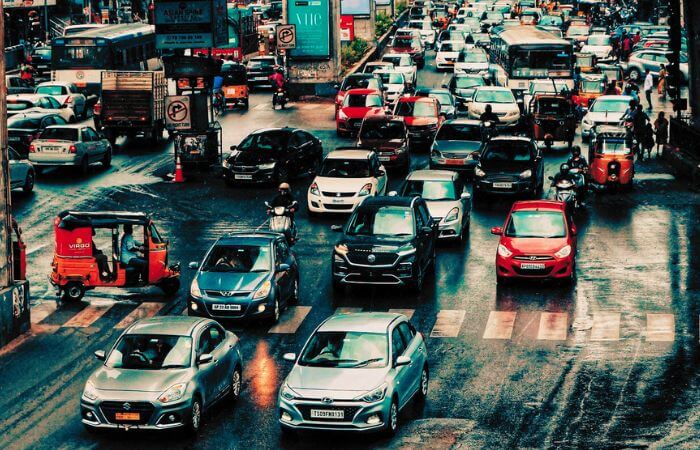
The amount of CO₂ emitted from travel differs significantly depending on how we get around.
To begin with, let’s look at how much carbon footprint is generated when one person travels one kilometre, depending on the mode of transport…
Walking or cycling : almost zero
Train : about 20〜30g
Bus : around 80g
Private car (petrol) : about 150〜200g
At this point, you might be wondering why private cars have higher emissions than buses.
The main reason is that they are far less efficient in terms of the number of people they carry.
Buses and trains move lots of people at the same time, so their emissions are shared. Private cars, by contrast, usually carry only one or two people, so the emissions cannot be shared in the same way.
…And when you fly, the carbon footprint increases dramatically.
On short-haul flights, such as London to Paris or Tokyo to Osaka, emissions can easily exceed 250 g per kilometre.

Planes use the most fuel when taking off and climbing. On short flights, this inefficient part of the trip makes up a bigger proportion, so emissions per kilometre are higher.
So, as you can see, even if you go the same distance, the emissions can be many times higher or lower just depending on how you travel.
And to put it into perspective, that’s about the same kind of difference you’d see between a diet focused on beef and one based mostly on beans and vegetables.
How everyday travel emissions add up over time
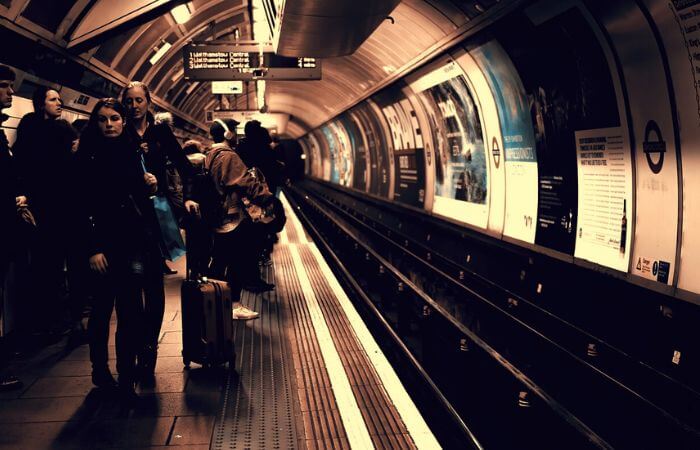
When it comes to the carbon footprint of transport, air travel for trips often gets the most attention.
But daily travel, like commuting to work or school, can add up to a significant amount over a year.
Let’s take a 10 km one-way commute as an example.
Driving 20 km round-trip in a private car with just one person produces about 3〜4kg of CO₂ per day. By contrast, traveling the same distance by train keeps emissions down to around 0.5kg.
On a day-to-day basis, the difference might feel like only a few kilos, but it really adds up.
If this is repeated five days a week for a year, a private car produces roughly 800kg of CO₂, while taking the train results in about 100kg — a difference of around 700kg.
This is equivalent to the emissions from taking several short-haul flights!
*London to Paris is around 340km, and Tokyo to Osaka is about 400〜500 km, so let’s take an average of 400km…
250g × 400km = 100,000g (100kg of CO₂),
which is equivalent to about seven flights.
In short, it’s not just your special trips that matter — the way you travel every day really affects your carbon footprint.
The sharp rise in CO₂ emissions from air travel
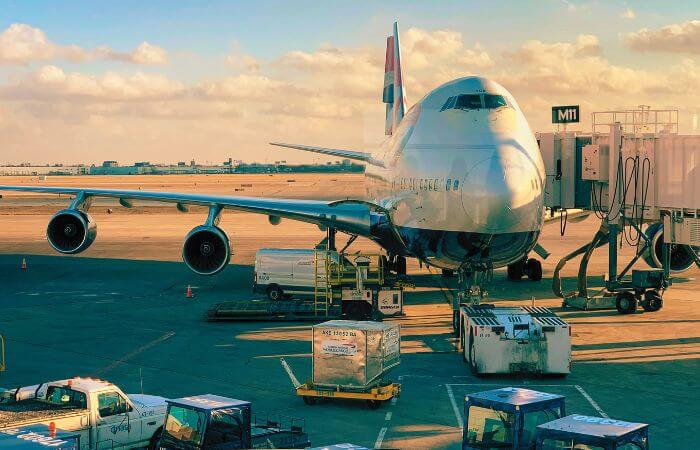
Even so, we need to keep in mind the effect of flying.
Compared to other ways of getting around, aeroplanes emit a lot more CO₂ in just one trip.
For instance…
A round-trip flight between Tokyo and Seoul generates about 300〜400kg of CO₂.
A long-haul flight from Tokyo to London produces roughly 1.5〜2tonnes.
This shows that a single long-distance flight can equal several months — or even a year — of emissions from everyday life.
All the emissions you might save by adjusting your diet for a whole year can be easily wiped out by just a single flight.
So, what can we do?

You don’t have to be perfect with your diet or the way you travel. Just making small choices where you can still helps cut CO₂ emissions.
That said, there’s one more reality we shouldn’t overlook.
This means that, if the people who produce most of the emissions don’t change their ways, overall cuts won’t keep up.
Not everyone contributes equally to climate change.
The top 10% of the world’s wealthy population produce more than 50% of total emissions worldwide.

Among them are people who take dozens of flights a year for work or leisure, as well as those using private jets that emit huge amounts of CO₂ in a single trip.
As long as high-emission travel goes unchecked, no matter how many people start walking, cycling, or taking public transport, we just won’t get the overall reductions we need.
That’s why, alongside our personal efforts, we need to come together and push for rules and systems that put a real limit on these high-emission ways of traveling.
Choosing to walk, cycle, or take public transport.
And at the same time, speaking up and putting pressure on politicians.
It’s only by doing both that a realistic path to slowing global temperature rise comes into view.
Until next time,
konkaz
*You can read this blog post in Japanese from the link below.
👉 私たちの移動はどれだけ地球を温めているのか?カーボンフットプリントで考える